


Summary: An off-plan mortgage in Dubai lets you finance a property that’s still under construction, but banks don’t release funds at booking. Most lenders step in once the project hits a set construction milestone, usually 30–50% complete, and after you’ve already paid a meaningful share of the price in cash. Your deposit, rate, and lender options depend on whether you’re a resident expat, UAE national, or non-resident investor. CityMortgage compares 25+ UAE lenders to match you to the right one.
Dubai’s real estate market recorded over 270,000 transactions worth AED 917 billion in 2025, a 20% rise year on year. A large share of that volume is off-plan property, bought before a single floor is poured.
But here’s where most buyers get stuck. You’ve found a project you like. The developer wants a booking deposit. And then someone mentions a mortgage, and suddenly the questions stack up fast. Does the bank lend on it now? Do you pay the developer first? When does the mortgage actually start?
Off-plan mortgage financing in Dubai works very differently from buying a ready property. The rules around timing, deposit requirements, and lender eligibility are specific, and getting them wrong means scrambling for cash at the wrong moment in the construction cycle.
This guide explains exactly how an off-plan mortgage in Dubai works, how much you’ll need upfront, and what changes depending on your buyer profile. If you’re a resident expat, UAE national, non-resident investor, or first-time buyer, the rules are not all the same.
What Is an Off-Plan Mortgage in Dubai, and How Does It Differ from a Ready-Home Loan?

An off-plan mortgage in Dubai finances a property that hasn’t been completed yet. Unlike ready-property loans, the bank doesn’t release the full loan amount at purchase — funds are disbursed in stages, tied to verified construction milestones, and only after the buyer has paid a defined portion of the price in cash first.
This is the part most articles don’t explain clearly enough. With a ready property, the mortgage is straightforward: the bank lends, you pay the seller, and you move in. With off-plan, the purchase sits in a construction window, sometimes 2–4 years, where the bank isn’t involved at all in the early stages.
The developer collects instalments from you directly during construction. The bank steps in later, once construction has reached a threshold that the lender considers low-risk enough to finance. That threshold varies by bank and project, but most UAE lenders require the building to be at least 30–50% complete before they’ll fund an off-plan mortgage.
CityMortgage brokers residential mortgage options across both ready and off-plan transactions, and the single biggest question we field on off-plan deals is: “When does the mortgage actually start?” The answer depends on the bank, the developer, and how much of the price you’ve already paid yourself.
If you want to understand how UAE mortgages work as a general foundation, that’s a good starting point before diving into off-plan specifics.
If you’re comparing off-plan with ready-property financing and wondering which makes more financial sense for your situation, the next section starts with the one number everyone searches for first: the deposit.
How Much Deposit Do You Need for an Off-Plan Mortgage in Dubai?
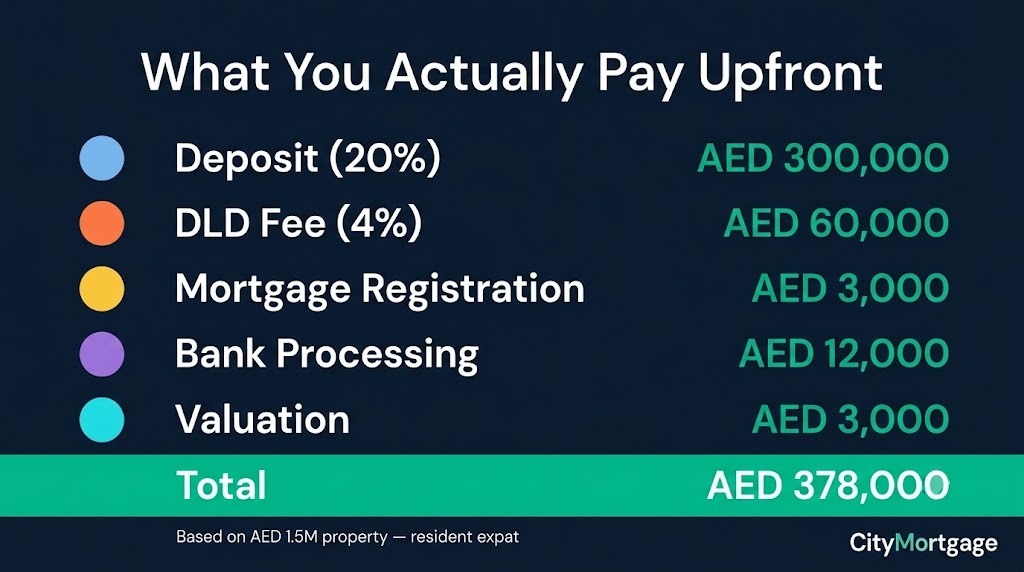
For a resident expat buying an off-plan property under AED 5 million, the minimum deposit is 20% of the purchase price, in line with CBUAE mortgage regulations. UAE nationals qualify from 15%. Non-residents must put in at least 35%, and in practice, many off-plan lenders ask for more on construction-stage deals.
Here’s what that looks like on a real number. For an AED 1.5 million off-plan apartment:
| Buyer Type | Min. Deposit (%) | Min. Deposit (AED) | Mortgage Max (AED) |
|---|---|---|---|
| UAE National | 15% | AED 225,000 | AED 1,275,000 |
| Resident Expat | 20% | AED 300,000 | AED 1,200,000 |
| Non-Resident | 35% | AED 525,000 | AED 975,000 |
But that deposit is not the only cash you need on day one. Off-plan buyers must also budget for upfront fees that sit on top of the property price:
| Cost Item | Amount |
|---|---|
| DLD transfer fee | 4% of purchase price |
| Mortgage registration fee | 0.25% of loan amount |
| Property valuation | ~AED 2,500–3,500 |
| Bank processing fee | ~1% of loan amount |
| Developer admin fee | Varies by developer |
On that same AED 1.5M property, an expat resident’s total cash required before handover (deposit plus fees) typically lands between AED 380,000 and AED 430,000, before any construction instalments.
The DLD transfer fee of 4% is a statutory charge set by Dubai Land Department — it is not negotiable, regardless of what a developer or agent tells you.
One important clarification: the off-plan LTV shown above (maximum 60% for residents on construction-stage properties) is tighter than what’s available on a ready home. That 60% LTV figure comes from CityMortgage’s own lending data across 25+ bank partners, and it’s a commonly cited threshold for standard off-plan construction deals. Specific banks and projects may differ.
Once you know your deposit target, the next question every buyer asks is: exactly when does the bank step in during the construction period?
Free Calculator
How much cash will you actually need?
Adjust the price and your profile — see your full upfront cost in real time.
Your upfront cost breakdown
Deposit (20% — expat first purchase)
Paid to developer before bank steps in
AED 300,000
DLD transfer fee (4%)
Statutory fee — Dubai Land Department
AED 60,000
Mortgage registration (0.25%)
On the loan amount
AED 3,000
Bank processing fee (~1%)
Varies by lender — indicative figure
AED 12,000
Property valuation
Bank-appointed valuer
AED 3,000
Total cash you need upfront
Based on 80% LTV — expat first purchase
AED 378,000
Figures are indicative based on standard CBUAE LTV rules and current DLD fee rates. Bank processing fees and valuation costs vary by lender. Speak to a CityMortgage advisor for your exact number.
Ready to check if you qualify for this mortgage?
CityMortgage compares 25+ UAE lenders — free, same-day assessment.
WhatsApp us — it’s free+971 54 206 5454 · RERA Licensed · No obligation
Powered by CityMortgage · citymortgage.ae
When Do Banks Actually Start Financing an Off-Plan Property in Dubai?
Most UAE banks won’t release mortgage funds at the time of booking. Lenders typically require the project to reach 30–50% construction completion, and they want confirmation that the buyer has already paid a meaningful share of the purchase price — often 20–30% — before the loan is activated.
This is where many buyers get caught off guard. You book a property on a 10/90 plan (10% now, 90% on handover). You assume the bank will fund the 90% at handover. Some lenders will, but many want to see you contribute more in cash during construction before they’ll extend a mortgage at completion.
The sequence most buyers actually go through looks like this:
- Pay booking deposit to developer (typically 5–10% of price)
- Pay construction instalments to the developer directly (no bank involved)
- Once the project hits the lender’s construction milestone (30–50%), apply for pre-approval
- The bank sends a valuer to inspect the progress
- Bank issues formal mortgage offer letter (1–2 weeks)
- At handover, the bank funds the remaining balance to the developer
- The mortgage is registered with DLD
In our experience handling off-plan mortgage applications across 25+ UAE lenders, milestone thresholds are not uniform. Banks like Emirates NBD typically move at 30–40% construction completion for approved developers, while more conservative lenders — including some Islamic banks — hold out until 50% or even practical completion is confirmed.
FAB and ADCB sit somewhere in between, and their thresholds can flex depending on the developer’s track record and project escrow compliance. What this means practically: if you’re buying in a newer development from a smaller developer, expect the bank to want more construction progress before they’ll commit — and plan your cash installments accordingly.
Some banks are now moving earlier in this timeline. Emirates NBD opened earlier mortgage access for off-plan Dubai Holding properties, allowing conditional pre-approvals before the standard completion threshold. This is still developer-specific, not a blanket market shift.
The full CityMortgage transaction timeline from pre-approval to DLD registration typically runs 4–6 weeks for the mortgage stage itself. But for off-plan deals, that clock doesn’t start until the construction milestone is reached.
Understanding this timeline also answers the next question: if the developer offers their own payment plan, why would you bother with a bank at all?
What Is the Difference Between a Developer Payment Plan and an Off-Plan Mortgage?
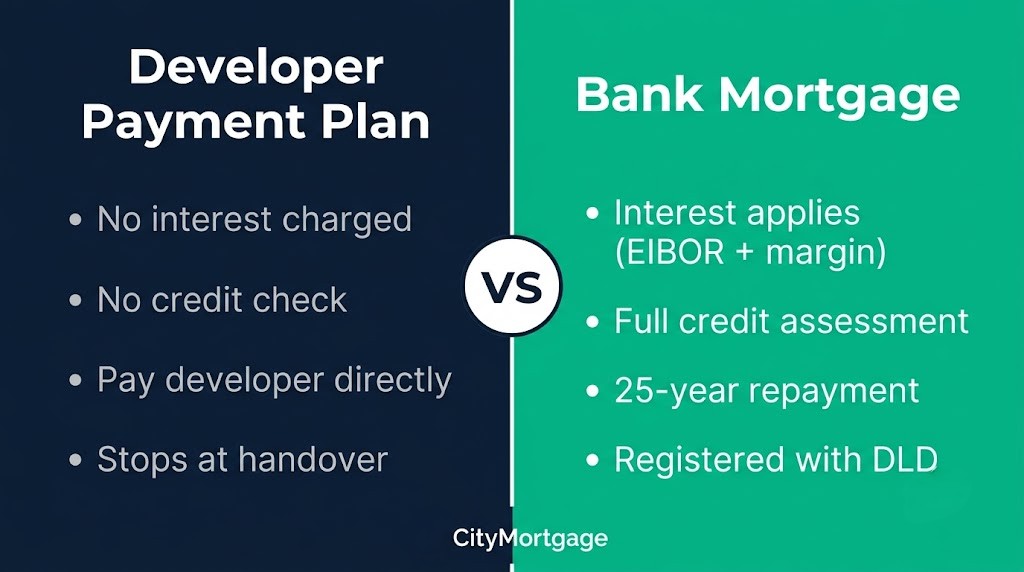
A developer payment plan lets you pay for the property in instalments directly to the developer, with no bank involved, no interest charged on those payments, and no DBR or credit assessment required.
A bank mortgage is a formal loan with interest, a credit check, monthly repayments, and regulatory oversight. Many buyers end up using both — the payment plan during construction, then a mortgage at or near handover.
This is probably the most misunderstood area of off-plan buying in Dubai. Here’s a clear side-by-side:
| Feature | Developer Payment Plan | Bank Mortgage |
|---|---|---|
| Interest charged | No (on the instalments) | Yes (EIBOR + margin) |
| Credit check required | No | Yes (AECB score check) |
| DBR limit applies | No | Yes (50% of gross income) |
| Who holds title deed | Developer until completion | Bank registers charge with DLD |
| Typical structure | 20/80, 40/60, post-handover plans | 25-year amortising loan |
| Flexibility if delayed | Negotiable with developer | Pre-approval may expire |
Post-handover payment plans (where you continue paying the developer for 1–3 years after you move in) are a growing trend in Dubai. These can work well for investors buying for rental yield, because the rental income covers the instalments during that period.
A bank mortgage usually makes more sense when you’re looking to lock in a long-term repayment period (up to 25 years), when the developer’s plan doesn’t cover the full price gap, or when you want to preserve cash flow rather than tie up capital in lump-sum payments.
A pattern we see regularly at CityMortgage: a client secures a 30/70 payment plan from a mid-tier developer in Dubai South or JVC. They pay the 30% in installments over the construction period, then approach us 3–4 months before handover to arrange the 70% mortgage. This works well when the client has maintained stable employment and clean bank statements throughout construction.
Where it goes wrong is when a buyer changes jobs, takes on additional debt, or lets their bank statements show irregular income in the months before applying — all of which tighten the bank’s assessment just when you need it to be smooth. Our advice is to treat the construction period like a quiet zone for your finances: pay down existing debt where possible, avoid new car loans or credit cards, and keep your documents ready to submit at short notice.
The group of buyers with the most questions about whether to use a plan or a mortgage tends to be non-residents. Their options look quite different from those of resident expats, and the next section covers that directly.
Can Non-Residents Get an Off-Plan Mortgage in Dubai?
Yes. Non-residents can get an off-plan mortgage in Dubai, but the lender pool is narrower, the minimum deposit is higher, and documentation requirements are stricter. Most banks set a maximum LTV of 60–65% for non-residents on off-plan deals, meaning you’ll need to fund at least 35–40% of the price in cash before the bank contributes.
Not every UAE bank lends to non-residents, and even fewer will consider non-resident off-plan applications on construction-stage properties. The banks that do lend typically require:
- Passport and national ID (KYC documents)
- 6 months of personal bank statements
- Salary certificate (30-day validity for salaried applicants)
- Proof of address from the country of residence
- Minimum account balance of AED 45,000 at some lenders
For self-employed non-residents, the requirements extend to trade license documents and company bank statements. The income verification standard is often higher than for salaried applicants in the same category.
One common myth worth correcting here: non-residents are not locked out of UAE mortgage financing. Banks like HSBC UAE, Standard Chartered, and select others have structured non-resident mortgage products. The rate premium is real — CityMortgage currently sees non-resident starting rates from approximately 4.24% compared to 3.75% for residents — but the financing is available.
Because the lender pool for non-resident off-plan deals is smaller, working with an independent broker who has relationships across 25+ UAE banks is significantly more useful than approaching any single lender directly. CityMortgage handles non-resident applications remotely, fully via WhatsApp, for international investors who haven’t relocated to the UAE.
See our full non-resident mortgage service for a complete breakdown of documentation and lender eligibility by country.
If you’re not a non-resident but a first-time buyer in the UAE, there’s an official DLD program you may qualify for that most mortgage articles skip over entirely.
Is the DLD First-Time Buyer Program Available for Off-Plan Mortgages in Dubai?
Yes. The DLD First-Time Home Buyer program gives eligible UAE residents priority access to off-plan properties under AED 5 million, along with preferential pricing from participating developers and flexible payment options for DLD registration fees. Participating banks provide mortgage offers directly within the program.
Here’s what the program offers in practice:
- Priority access to off-plan projects before general release
- Preferential pricing from developer partners
- Flexible DLD registration fee payment (rather than a lump-sum upfront)
- Mortgage offers from participating banks within the program framework
- No extra application fee for the program itself — standard DLD fees and bank charges still apply
The program is aimed at UAE residents, not non-residents, and the property value cap is AED 5 million. It’s particularly useful for expat professionals who are buying for the first time and want to avoid the cash pressure of paying the full DLD transfer fee (4% of property price) as a single upfront cost.
The DLD First-Time Buyer program doesn’t waive the 4% DLD transfer fee — it allows flexibility in how it’s paid. That’s a meaningful difference for buyers managing cash flow across a multi-year construction period.
One thing to note: the program works through licensed Dubai brokers and participating developers. A RERA-licensed mortgage broker can confirm whether a specific project qualifies before you commit.
The risk most buyers don’t ask about until too late is: what happens if the project you’ve bought into gets delayed?
What Happens to Your Off-Plan Mortgage Pre-Approval If Construction Is Delayed?
If a developer delays handover, your mortgage pre-approval may expire before the property is ready, requiring a full reapplication. Rate conditions and lender policies can change in that window. The best protection is confirming the project is RERA-registered and that the developer holds an escrow account for buyer funds.
UAE mortgage pre-approvals typically run for 60–90 days. For off-plan deals, where the construction period can stretch 2–4 years, this means the formal bank approval only becomes relevant closer to the handover date, not at booking.
Here’s what to check before committing to any off-plan project:
- Confirm the project is registered with RERA (searchable on the Dubai REST app)
- Verify the developer holds a RERA-approved escrow account for your installments
- Ask your broker which lenders have pre-approved this project or developer
- Understand what happens to your paid installments if the project is delayed or cancelled
RERA’s escrow account requirement means developers must hold buyer funds in a supervised account tied to the project, not divert them. This is one of the key protections Dubai introduced after the 2008 market correction.
If a project is delayed beyond the contracted handover date, buyers typically have the right to claim compensation under the Sales and Purchase Agreement. For mortgage purposes, the key risk is the rate environment shifting between pre-approval and actual disbursal. CityMortgage monitors this for clients and flags renewal windows proactively.
Now that you understand the risks and protections, let’s look at the current rate environment so you can model what an off-plan mortgage would actually cost you per month.
What Mortgage Rates Apply to Off-Plan Properties in Dubai in 2026?
UAE mortgage rates in 2026 are variable-first in structure, meaning most deals start with a fixed period of 1–5 years and then revert to a floating rate based on EIBOR (Emirates Interbank Offered Rate) plus the bank’s margin.
As of June 2026, the 3-month EIBOR is approximately 3.79%, based on published UAE interbank rate data. Most lenders add a margin of 1–1.5% on top of EIBOR for the variable period. That puts variable-rate mortgages in the low-to-mid 5% range once the fixed period ends, depending on lender and profile.
For the fixed initial period, CityMortgage currently sees resident expat starting rates from approximately 3.75% on competitive off-plan and ready-property deals. Non-resident mortgage rates start from approximately 4.24% on comparable products.
Rate types available on UAE off-plan mortgages:
| Rate Type | Structure | Best For |
|---|---|---|
| Fixed rate (1–5 years) | Set rate for fixed term, then EIBOR + margin | Buyers who want repayment certainty in early years |
| Variable rate | EIBOR + bank margin throughout | Buyers who expect rate falls or plan to sell/refinance |
| Islamic (Diminishing Musharaka / Ijara) | Profit rate, not interest — Sharia-compliant | Buyers who prefer Islamic finance structure |
One myth worth correcting directly: Islamic finance is not automatically more expensive than conventional. The real comparison is total monthly cost, all fees included, across the full tenure. CityMortgage runs both conventional and Islamic options side-by-side for every client, and the difference varies by lender and loan size rather than following a consistent pattern.
When we run Islamic and conventional options side-by-side for off-plan clients in mid-2026, the profit rate difference is often smaller than buyers expect — typically within 0.15–0.30% of each other at the fixed-period level. Where Islamic finance sometimes wins on total cost is in the fee structure: some Islamic banks charge lower or zero processing fees, which on a AED 1.5M loan saves between AED 7,500 and AED 15,000 upfront.
For buyers who are not specifically seeking a Sharia-compliant product, the decision often comes down to which lender has the better relationship with the specific developer, not the rate label. That’s exactly why we run both simultaneously rather than directing clients toward one structure from the start.
For a personalised rate comparison across 25+ UAE lenders for your specific profile, WhatsApp us directly — see the section below.
Your Off-Plan Mortgage Checklist: What to Do Before You Book
Before signing anything with a developer, run through this checklist. It saves a lot of painful backtracking later.
Before Booking:
- Get a mortgage eligibility assessment (takes 20 minutes with CityMortgage)
- Confirm your income qualifies under DBR rules (max 50% of gross income toward all debt payments)
- Check your AECB credit score — lenders will run this during the application
- Confirm the project is RERA-registered, and the developer holds a RERA escrow account
- Check that the developer is on at least one UAE lender’s approved list
During Construction:
- Keep 6 months of bank statements up to date — lenders will re-request these at the mortgage stage
- Track the construction completion percentage — your mortgage window opens around 30–50%
- Don’t change jobs mid-construction if you can avoid it — lenders want employment continuity
- Renew your residence visa well before it expires — visa status affects mortgage eligibility
At Handover:
- Get a formal bank valuation (bank-appointed, not developer-issued)
- Budget for DLD registration fees, mortgage registration (0.25% of the loan), and valuation cost
- Confirm your pre-approval letter is still valid — renew if needed
- Coordinate DLD transfer appointment through your broker
Free Eligibility Quiz
Can you get an off-plan mortgage in Dubai?
3 quick questions — see your deposit, LTV, and next step.
What best describes your situation?
What is your gross monthly income?
What is your target property price?
Your eligibility result
You likely qualify
Based on your profile
Min. deposit required
20%
Of property price
Max loan (LTV)
80%
CBUAE regulated
Est. starting rate
From 3.75%
Fixed 1–5 years
Est. cash needed
~AED 378K
Deposit + fees
Based on your answers, a CityMortgage advisor can check 25+ lenders to find the right match for your profile. Figures are indicative — your exact numbers depend on the property and lender selected.
Get your personalised lender match — free
CityMortgage compares 25+ UAE banks. Same-day response, zero obligation.
+971 54 206 5454 · RERA Licensed · No obligation
Powered by CityMortgage · citymortgage.ae
FAQ — Off-Plan Mortgages in Dubai
What is an off-plan mortgage in Dubai?
An off-plan mortgage in Dubai is a bank loan used to finance a property that's still under construction. Unlike ready-home mortgages, the bank doesn't release the full loan at booking. Funds are disbursed once the project reaches a set construction milestone, typically 30–50% complete, and after the buyer has already paid a portion of the price directly to the developer.
Can expats get an off-plan mortgage in Dubai?
Yes. UAE resident expats can get an off-plan mortgage in Dubai with a minimum deposit of 20% for properties under AED 5 million, under CBUAE regulations. The LTV available on off-plan construction-stage deals is typically up to 60%, which is lower than the 80% available on ready properties. Lender choice varies by project and developer approval status.
How much do I need upfront for an off-plan mortgage in Dubai?
For a resident expat, you need at least 20% of the property price as a deposit, plus approximately 4% for DLD transfer fees, 0.25% for mortgage registration, and around AED 2,500–3,500 for valuation. On a AED 1.5M property, total cash required before the bank funds the mortgage typically ranges from AED 380,000 to AED 430,000.
Which banks offer off-plan mortgages in Dubai?
Major UAE banks including Emirates NBD, ADCB, FAB, Mashreq, HSBC UAE, and Standard Chartered offer off-plan mortgage products, subject to developer and project approval. Islamic options are available through DIB, ADIB, and Emirates Islamic. Not every bank lends on every project. CityMortgage checks across 25+ lenders simultaneously to identify which ones will finance your specific property.
Is EIBOR fixed or variable on UAE mortgages?
EIBOR is a floating benchmark rate that changes based on interbank market conditions. It is not fixed. In most UAE mortgage structures, the bank's margin (typically 1–1.5%) is fixed, but the EIBOR component moves. Fixed-rate periods of 1–5 years lock your full rate for that period, after which the rate reverts to the floating EIBOR-plus-margin structure.
Ready to Find Out If You Qualify for an Off-Plan Mortgage in Dubai?
Off-plan financing in Dubai is possible, but it's milestone-based, lender-specific, and very different from buying a ready property. The earlier you get an independent eligibility assessment, the clearer your cash position will be before you commit to any booking.
CityMortgage is a RERA-licensed independent mortgage broker based in Dubai. We compare 25+ UAE lenders across conventional and Islamic options, for residents, non-residents, salaried professionals, and self-employed buyers.
WhatsApp CityMortgage now at +971 54 206 5454 for a free, same-day eligibility assessment. We'll tell you exactly what you qualify for, which lenders will consider your off-plan project, and what your actual upfront cash requirement will be — with full transparency and zero obligation.
Disclaimer
The information in this article is provided for general guidance only and reflects market conditions, regulatory rules, and indicative rates as of the date of publication. Mortgage eligibility criteria, LTV ratios, interest rates, DLD fees, and lender policies can change without notice and vary by individual profile, property, and bank assessment.
Nothing in this article constitutes financial, legal, or mortgage advice. CityMortgage recommends you obtain a personalised assessment before making any property finance decision.
For the most current figures and eligibility requirements, please refer to the Central Bank of the UAE (CBUAE), Dubai Land Department (DLD), and your chosen lender directly — or speak to a licensed mortgage advisor.
City Axis Mortgage Broker L.L.C. is a RERA-licensed mortgage broker (ORN: 58708). Full terms available at citymortgage.ae/terms-conditions.

Very informative article! I learned a lot about choosing the right off plan properties dubai for investment and future returns.
[…] LTV for everyone, resident or not, because of construction risk. That single rule can rule out an off-plan Dubai South unit for a buyer who assumed they’d only need 20% […]