


Summary: In 2026, UAE mortgage eligibility depends on your residency status, income type, and debt burden ratio. Expat residents need a minimum 20% deposit; UAE nationals qualify from 15%; non-residents need 35%. The Central Bank of the UAE caps total debt repayments at 50% of gross monthly income. This guide breaks down who qualifies, how much you can borrow, how much cash you need at closing, and exactly what to do next.
Dubai recorded 267,499 property transactions in 2025, with average prices up 18% year-on-year to around AED 1,976 per square foot, according to DXB Analytics market data. Despite record-breaking demand, thousands of buyers approach UAE banks without knowing their eligibility category — and many get declined for reasons that are entirely avoidable.
UAE mortgage eligibility is not one-size-fits-all. Your residency status, income type, existing debt, and the type of property you are buying all change the rules. Getting this wrong means delays, rejections, or worse — agreeing to buy a property you cannot finance.
This guide gives you a clear decision path: whether you can apply, how much you can borrow, the full cash you need at signing, and the exact steps to move forward in 2026.
Who Is Eligible for a UAE Mortgage in 2026?

UAE mortgages are available to expat residents, UAE nationals, non-resident international investors, and self-employed professionals. Eligibility depends on your residency status, age, income source, and debt burden ratio as set by the Central Bank of the UAE.
The UAE Central Bank’s mortgage framework under Circular 31/2013 governs what every bank must follow. Individual lender policies sit on top of those rules — which is why the same applicant can get approved at one bank and declined at another.
Here is the eligibility picture by buyer type:
| Buyer Type | Eligible? | Key Conditions |
|---|---|---|
| UAE national (salaried) | Yes | Min. 15% deposit, age 21–65 at loan end |
| Expat resident (salaried) | Yes | Min. 20% deposit, valid UAE residency visa |
| Non-resident investor | Yes | Min. 35% deposit, stricter underwriting |
| Self-employed (resident) | Yes | 2 years audited accounts, higher income threshold |
| Self-employed (non-resident) | Yes | Hardest to qualify — broker route strongly recommended |
Age limits apply at loan maturity, not application: typically 65 for salaried applicants, 70 for self-employed. Minimum age is 21 at most lenders.
Once you know your category, the next question is how much of your income a bank will lend against.
What Is the Minimum Salary to Get a Mortgage in the UAE?
Most UAE banks require a minimum monthly salary of AED 15,000 for salaried applicants and AED 25,000 for self-employed. Some lenders accept AED 10,000 for lower-value properties. There is no CBUAE-mandated minimum — bank policy sets the floor.
Because lender thresholds vary, your salary might pass at one bank and fall short at another. This is one of the clearest practical advantages of working with an independent broker: we compare 25+ UAE lenders simultaneously and identify which ones will work with your specific income level and employment type.
For self-employed applicants, most banks require:
- Two years of audited financial statements
- UAE trade licence (if resident)
- Evidence of consistent income — not just a strong recent year
- Business bank statements for the last 12–24 months
Additional income such as rental income, overseas salary, or investment returns can count toward qualifying, but banks apply a discount (typically 50–70% of gross additional income). Declare all income sources — it can meaningfully increase your borrowing capacity.
In our experience, the buyers who struggle most with salary thresholds are those with income split across multiple sources — a base salary below AED 15,000 combined with a regular bonus, commission, or overseas income that brings their real monthly earnings well above what any single bank’s minimum requires.
Most banks will only count guaranteed basic salary toward the minimum threshold. Variable pay, bonuses, and overseas income are either discounted or excluded at the eligibility screening stage — even if the buyer has received them consistently for three or four years.
Where this matters most is for mid-level professionals in sectors like hospitality, retail, and sales, where base salaries are structured low and variable pay makes up a significant portion of total compensation.
We regularly work with buyers in this situation and identify lenders whose policies allow a more complete picture of income to be assessed. That single change — choosing the right lender for the income structure — is often the difference between a declined pre-approval and a successful one.
If salary is the starting point, your Debt Burden Ratio is what determines the ceiling.
What Is the Maximum DBR Limit for UAE Mortgage Approval?
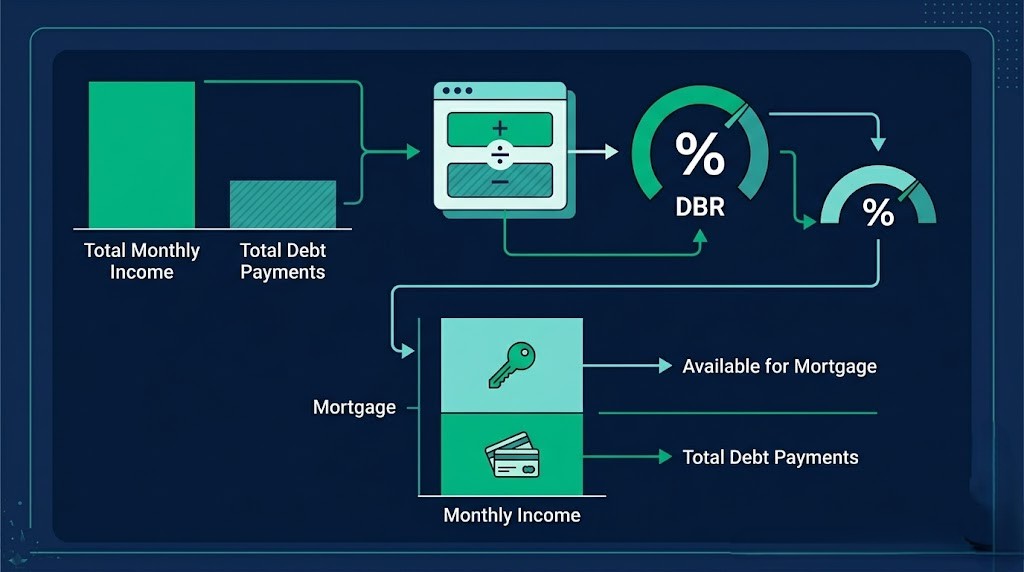
The Central Bank of the UAE caps the Debt Burden Ratio at 50% of gross monthly income for all borrowers. This means every monthly debt repayment combined — credit cards, car loans, personal loans, and your new mortgage — must not exceed half your monthly salary.
This is set by CBUAE regulation and applies to every licensed bank and lender in the UAE.
How DBR works in practice:
| Item | AED |
|---|---|
| Gross monthly salary | 25,000 |
| Maximum total debt payments (50% DBR) | 12,500 |
| Existing car loan repayment | 2,000 |
| Maximum mortgage payment available | 10,500 |
At AED 10,500 per month over 25 years at approximately 4% interest, that borrower qualifies for a loan of roughly AED 1.64 million.
Important exception: A CBUAE notice issued July 2023 allows lenders to apply a higher DBR deduction rate of up to 60% for customers earning AED 40,000 or more per month. This increases borrowing capacity meaningfully for higher-income applicants — and is a rule many buyers and even some bank staff are not aware of.
Buyers earning AED 40,000+ per month may qualify for a higher DBR allowance under a 2023 CBUAE relief measure — increasing their maximum mortgage payment beyond the standard 50% cap.
Once you know your maximum monthly payment, the LTV rules tell you how much deposit you need.
How Much Down Payment Do You Need for a UAE Mortgage in 2026?

UAE down payment requirements are fixed by the Central Bank of the UAE and depend on your residency status and the property value. Expat residents need 20% for properties under AED 5 million; UAE nationals need 15%; non-residents need at least 35%.
These are minimum requirements under CBUAE Circular 31/2013. Individual banks can require more — they cannot go below.
| Buyer Type | Property Under AED 5M (Max LTV) | Property Over AED 5M (Max LTV) | Min Deposit |
|---|---|---|---|
| UAE National | 85% | 75% | 15% |
| Expat Resident | 80% | 65% | 20% |
| Non-Resident | 65% | 65% | 35% |
Off-plan properties have separate rules. Banks typically lend up to 50% LTV on off-plan purchases, which means a 50% deposit — or the developer’s payment plan covers the construction phase, and the bank finances the completed property.
Worked examples at common price points:
| Property Price | Buyer Type | Max Loan | Min Deposit |
|---|---|---|---|
| AED 1,500,000 | Expat resident | AED 1,200,000 | AED 300,000 |
| AED 1,500,000 | UAE national | AED 1,275,000 | AED 225,000 |
| AED 1,500,000 | Non-resident | AED 975,000 | AED 525,000 |
| AED 3,000,000 | Expat resident | AED 2,400,000 | AED 600,000 |
| AED 6,000,000 | Expat resident | AED 3,900,000 | AED 2,100,000 |
The deposit is the largest single cost — but it is not the only cash you need at signing.
UAE Mortgage Eligibility Checker 2026
Select your buyer type to see your rules, then enter your details to calculate your maximum loan and total cash to close.
Step 1 — Select Your Buyer Type
Min. down payment (under AED 5M)20%
Max. LTV (under AED 5M)80%
DBR limit50% of gross income
Typical min. monthly salaryAED 15,000
Max. age at loan end65 years
UAE residency visa requiredYes
Step 2 — Calculate Your Maximum Loan
AED
AED
AED
Max Loan Amount
—
Required Deposit
—
DLD Fee (4%)
—
Mortgage Reg + Fees (est.)
—
Total Cash to Close (est.)
—
Get your exact eligibility from a licensed broker
CityMortgage compares 25+ UAE lenders — no bank bias, free same-day assessment.
Book on WhatsApp
Estimates based on CBUAE LTV rules and current DLD fee schedule. Figures are indicative only. Final eligibility subject to individual lender assessment. RERA ORN 58708.
What Are the Full Upfront Costs When Buying Property in Dubai with a Mortgage?
Most buyers budget for the deposit and underestimate everything else. On an AED 2 million property, the total cash required at signing typically exceeds AED 540,000 — nearly double the deposit alone.
Here is the full cash-to-close breakdown for an AED 2 million property purchased by an expat resident:
| Cost Item | Rate | AED Amount |
|---|---|---|
| Deposit (20% LTV) | 20% | 400,000 |
| DLD transfer fee | 4% of property price | 80,000 |
| Mortgage registration fee | 0.25% of loan amount | 4,000 |
| Property valuation | Fixed fee | ~3,000 |
| Bank processing fee | ~1% of loan amount | ~16,000 |
| Agent commission | ~2% of property price | ~40,000 |
| Total estimated cash required | ~AED 543,000 |
The DLD mortgage registration fee of 0.25% applies to the loan amount and is a fixed government charge — not negotiable. The DLD transfer fee of 4% applies to the purchase price and is equally non-negotiable.
Common misconception: Many buyers assume the DLD fee is open to negotiation. It is not. It is a fixed government cost and must be factored into your cash planning before you make an offer.
As an independent broker, we walk every client through a full cash-to-close estimate before they sign anything. This is one of the most important conversations in the buying process — and one that banks rarely initiate.
Now that you have the full cost picture, here is how eligibility works for the two buyer types who get the most questions.
Can Non-Residents and Self-Employed Applicants Get a UAE Mortgage?
Non-residents can get UAE mortgages, but need a minimum 35% deposit and face tighter underwriting. Self-employed applicants need two years of audited accounts and typically a higher minimum income. Both groups get the best results applying through a broker with access to specialist lenders.
The biggest mistake non-residents make is approaching one bank, getting declined, and assuming they are not eligible. In reality, lender appetite for non-resident applications varies significantly. Some banks are cautious; others have specialist non-resident mortgage products. Explore the non-resident mortgage pathway to see which lenders are most open to international buyers in 2026.
For self-employed applicants, the documentation burden is higher but manageable:
Self-Employed Mortgage Document Checklist:
- Audited financial statements (2 years minimum)
- Business bank statements (12–24 months)
- UAE trade licence or equivalent business registration
- Proof of business ownership/shareholding structure
- Personal bank statements (6 months)
- AECB credit report
- Passport and visa copies
In our experience working with self-employed and non-resident buyers across Dubai, Abu Dhabi, and Sharjah, the most common reason applications get declined at a single bank has nothing to do with the buyer not qualifying. It comes down to a mismatch between how that bank calculates income and how the applicant actually earns.
A self-employed business owner earning AED 55,000 a month across a director’s salary, retained business profit, and rental income will get very different results depending on which bank reviews the file. Some lenders apply a 50% discount to non-salary income and exclude rental entirely. Others count all three streams at full value. Same applicant, same documents, completely different outcome.
Non-residents face a different version of the same problem. Lender appetite for non-resident applications shifts quietly and often — some banks tighten criteria for certain nationalities or property types without any public announcement. The only way to know who is actively approving non-resident files right now is to be in the market daily, which is exactly what an independent broker is.
We typically submit self-employed and non-resident applications to two or three lenders simultaneously, matched to the ones whose current criteria fit that buyer’s income profile. This approach consistently produces approvals for buyers who assumed a single-bank decline meant they were not eligible. In many cases, the approving lender also offers a sharper rate than the one that declined.
If you are self-employed or buying from outside the UAE, a broker conversation before any bank approach is the single most useful step you can take.
Step-by-Step: How to Apply for a UAE Mortgage in 2026

Your UAE mortgage application follows a clear sequence. Knowing the order protects you from delays and prevents costly mistakes.
Step 1 — Run your DBR calculation Add up all existing monthly debt payments. Subtract from 50% of your gross monthly income. The remainder is your maximum available mortgage payment.
Step 2 — Check your AECB credit score The Al Etihad Credit Bureau holds your UAE credit history. Banks check this during underwriting. Pull your own report first so there are no surprises. Clear any outstanding defaults or missed payments before applying.
Step 3 — Gather your documents Salaried applicants need: passport, visa, Emirates ID, 3–6 months salary slips, 3–6 months bank statements, employment letter, and AECB report. Self-employed applicants need the expanded list above.
Step 4 — Get mortgage pre-approval Pre-approval confirms the loan amount a bank will offer before you commit to a property. It typically takes 3–7 working days and is valid for 60–90 days. Do not make an offer on a property without it.
Step 5 — Finalise the property and complete underwriting Once your offer is accepted, the bank orders a property valuation (~AED 2,500–3,500). Full underwriting follows and typically takes 2–4 weeks from valuation.
Step 6 — DLD registration The final step is registering the mortgage and title transfer at the Dubai Land Department. The 0.25% mortgage registration fee and 4% DLD transfer fee are paid here. Processing through the online mortgage system takes approximately 15–20 minutes once all documents are submitted.
On interest rates in 2026: UAE variable-rate mortgages are priced against EIBOR (Emirates Interbank Offered Rate). Indicative current rates show the 3-month EIBOR at approximately 3.65% and the 6-month at approximately 3.64%. Major banks are currently offering fixed rates starting from approximately 3.49% to 3.8% for the initial fixed period (typically 1, 2, or 3 years), after which the rate reverts to EIBOR plus a lender margin. These are market estimates — always verify current rates when you apply.
Frequently Asked Questions
Is mortgage eligibility different in Dubai, Abu Dhabi, and Sharjah?
The core CBUAE rules for LTV and DBR apply across all emirates. However, property registration fees, local regulatory bodies, and lender appetite can differ. DLD governs Dubai registrations; Abu Dhabi has its own Department of Municipalities and Transport; Sharjah operates under SRERD. CityMortgage serves buyers across Dubai, Abu Dhabi, and Sharjah and handles emirate-specific requirements for each application.
Can I get a UAE mortgage if I already have existing debt?
Yes, but your existing debt directly reduces your borrowing capacity through the DBR calculation. A car loan of AED 2,000 per month, for example, reduces your maximum mortgage payment by the same amount. Paying down or clearing existing debt before applying is one of the most effective ways to increase your loan eligibility.
How does EIBOR affect my variable-rate mortgage in 2026?
EIBOR is a benchmark reference rate, not a fixed number. It moves with broader UAE monetary conditions. Your variable-rate mortgage is priced as EIBOR plus a fixed bank margin. When EIBOR rises, your monthly payment rises. When it falls, your payment falls. The fixed-rate period at the start of most mortgages (typically 1–3 years) protects you from short-term EIBOR movement. After that, your rate floats.
Is Islamic home finance harder to qualify for than a conventional mortgage?
No. The eligibility criteria for Islamic mortgages (typically Murabaha or Ijara structures) follow the same CBUAE LTV and DBR rules as conventional products. The difference is in the contract structure, not the qualifying criteria. Islamic finance is not automatically more expensive — the total cost depends on the specific product, bank pricing, and term.
How long does UAE mortgage pre-approval take?
Pre-approval typically takes 3–7 working days from submission of a complete document pack. Incomplete submissions are the most common cause of delays. An independent broker submits to multiple lenders simultaneously, which speeds up the process and gives you the best offer to work with.
Ready to Check Your UAE Mortgage Eligibility Today?
Most buyers spend weeks guessing whether they qualify before speaking to anyone. A 10-minute call with CityMortgage gives you a clear answer: your eligible loan amount, required deposit, estimated monthly payment, and total cash to close — across 25+ UAE lenders, with no bank bias.
WhatsApp CityMortgage now at +971 54 206 5454 for a free, same-day eligibility assessment. We compare 25+ UAE lenders and find the right mortgage for your profile — with full transparency and zero obligation.

[…] of that matters, though, until you know exactly what you can finance. Your mortgage eligibility, not the area's popularity, should be the first thing you […]