


Summary: Your AECB credit score affects UAE mortgage approval, but it’s not the only factor banks check. Lenders combine your score with income, DBR (debt burden ratio), and LTV limits to decide approval, pricing, and documentation requirements. This guide covers what score you actually need, how self-employed and non-resident applicants are assessed differently, and the steps to improve your score before you apply.
Your AECB credit score runs from 300 to 900, and checking it costs just AED 10.50 through the Al Etihad Credit Bureau app or UAE Pass. AECB, wholly owned by the UAE federal government, is the sole official credit bureau serving individuals and companies across the country. Most guides stop at the definition. What they don’t explain is what happens next: how that number actually plays into a bank’s mortgage decision.
A common assumption is that a high score guarantees approval. It doesn’t. UAE banks stress-test your repayment capacity at 2 to 4 percentage points above the actual mortgage rate, and they cap your debt burden ratio at 50% regardless of how strong your score is. Your AECB score opens the door. Your income, LTV eligibility, and documentation decide whether you walk through it.
This guide breaks down exactly how your score fits into the bigger Dubai mortgage picture, for UAE nationals, resident expats, self-employed applicants, and non-residents alike.
What Is an AECB Credit Score and Why Does It Matter for Your Mortgage?
Your AECB score is a three-digit number between 300 and 900, generated by the Al Etihad Credit Bureau, the main credit bureau in the UAE, from your payment history across banks, telecom providers, and utility accounts.
Banks pull this score during mortgage underwriting to gauge how reliably you’ve handled credit in the past. A longer, cleaner credit history generally supports a stronger score. You can see how Al Etihad Credit Bureau explains your credit score directly on its official site.
The score itself doesn’t set your interest rate or your maximum loan amount directly. What it does is signal risk. A lender uses it alongside your salary, employment type, and existing debts to decide whether to approve you, how much scrutiny your file gets, and occasionally, which rate tier you land in.
If you’re wondering what score actually counts as “good enough” for a mortgage application, the next section breaks that down by range.
What Factors Influence Your AECB Score the Most?
Your score is built from several data points pulled from active and closed credit accounts across UAE credit bureaus and lenders. The main factors include your payment history (the biggest weight), how much of your available credit limit you’re using across your credit cards and loans, the mix of credit facilities you hold, and how long you’ve maintained a positive credit history.
Consistently high credit card utilization, even without missed payments, can pull your score down. So can a thin credit history if you’ve only recently moved to the UAE. Multiple new credit applications in a short window also count against you, since each one triggers a fresh inquiry on your file.
How Is Your AECB Score Calculated?
Al Etihad Credit Bureau uses a statistical model, not a simple formula, to turn your credit behavior into a single number. The model weighs several data points from your credit profile: how consistently you make payments, how much of your available credit limit you use, how many active and closed credit facilities you hold, and how long you’ve held credit overall.
The final credit score is calculated using a mix of these weighted factors, similar to how international credit scoring models work, though AECB doesn’t publish its exact algorithm. What is public is that the score ranges from 300 to 900, and the higher your score, the lower the risk a lender assumes you represent.
Because your score updates as new data arrives from banks and telecom providers, it’s worth checking your score again close to your mortgage application date rather than relying on an old number.
What Is a Good AECB Credit Score for Mortgage Approval in the UAE?
A score above 700 is generally considered strong for UAE mortgage applications, while scores below 580 often trigger additional scrutiny or rejection, though banks vary in their exact cutoffs.
Most UAE banks don’t publish hard score cutoffs, and none of the major AECB explainer sites connect score ranges directly to mortgage outcomes. In practice, brokers see a consistent pattern: applicants in the 700-900 range typically face fewer document requests and faster underwriting.
Applicants in the 580-699 range often still qualify, but banks may request additional income verification or a co-applicant. Below 580, approval becomes lender-specific and harder, even with high income.
At CityMortgage, we typically see applicants with AECB scores in the 650-700 range get approved within our standard timeline, but self-employed applicants in that same range often need one extra round of bank statements before the file clears underwriting.
It’s worth noting mortgage underwriting is stricter than everyday credit card approvals. A score that comfortably clears a retail credit card application doesn’t always clear the bar for a multi-million-dirham mortgage, since the loan size and repayment term are far larger and the bank’s exposure is much higher.
Score alone doesn’t decide your loan size. The next section shows how DBR and LTV rules work alongside it.
How Do UAE Banks Use Your AECB Score Alongside DBR and LTV?
This is the part most competing guides skip entirely, and it’s the piece that actually determines what you can borrow.
The Central Bank of the UAE (CBUAE) caps your debt burden ratio (DBR) at 50%, meaning your total monthly debt obligations, mortgage included, can’t exceed half your income. Banks also stress-test your repayment ability at 2 to 4 percentage points above your actual mortgage rate, to confirm you could still afford payments if rates rise.
Your AECB score doesn’t override either rule. A 900 score with a DBR above 50% still gets declined. These limits come directly from the CBUAE Rulebook on important ratios, not from individual bank policy.
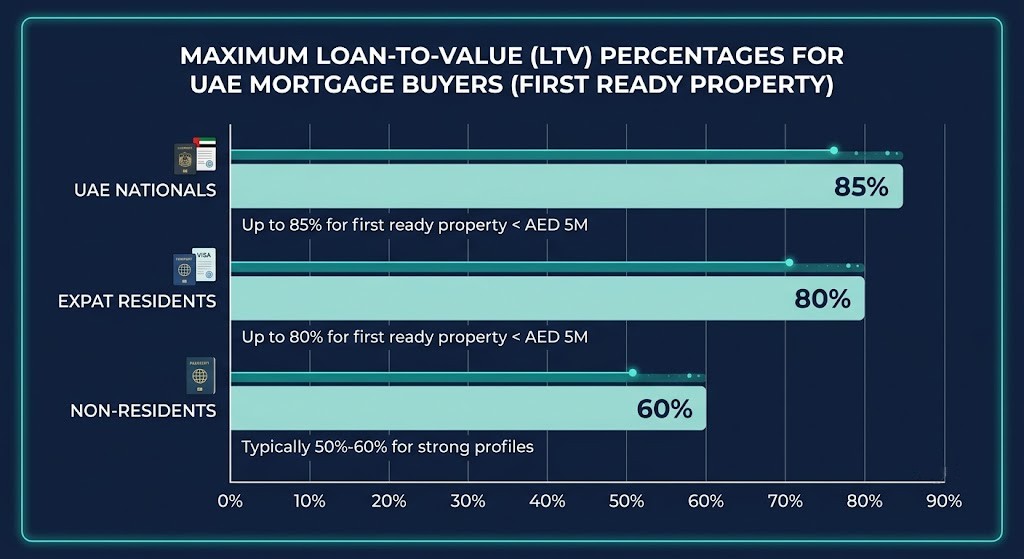
LTV limits (loan-to-value, or how much of the property price the bank will finance) also sit independently of your score:
| Buyer Profile | Max LTV | Notes |
|---|---|---|
| UAE Nationals | 85% | Includes pensioners |
| Expat residents, first purchase (≤AED 5M) | 80% | |
| Expat residents, second purchase | 75% | |
| Off-plan properties | 60% | Regardless of buyer type |
| Non-residents | 60-65% | Max tenor 25 years |
Financing caps also apply by residency: up to 8 years of annual income for UAE nationals, and 7 years for expats.
Your AECB score influences how smoothly you clear these checks, but DBR and LTV are the hard limits that decide your actual loan size.
Wondering whether a low score can still get you approved? The next section covers exactly that.
Can You Get a Mortgage with a Low AECB Score?
Yes, a low AECB score doesn’t automatically disqualify you, but it usually means more documentation, a smaller loan amount, or a longer approval process.
There’s a real difference between three situations that often get lumped together: a genuinely low score from missed payments, a thin file (little to no credit history, common for new UAE residents), and a file with specific negative items like a bounced cheque. Banks treat these differently. A thin file with strong salary and clean bank statements often gets approved with extra verification.
A low score from recent delinquencies faces tougher scrutiny, and a strong salary can sometimes offset it, but not always. Bounced cheques are treated more seriously than a simply average score.
If you’re not sure which of these applies to your situation, our residential mortgage eligibility guide walks through eligibility criteria by buyer type.
Does Your AECB Score Affect Non-Residents and Self-Employed Applicants Differently?
Non-residents and self-employed applicants aren’t excluded from UAE mortgages, a common myth, but they do face different documentation and LTV terms regardless of score.
Non-residents qualify for LTV up to 60-65%, with a maximum tenor of 25 years and typically a minimum balance requirement of around AED 45,000. Approval depends heavily on country of income and bank-specific assessment, in addition to AECB score.
Self-employed residents need a minimum of one year in business, a valid trade license, and can access up to 75% LTV. Because self-employed income is harder to verify than a salary certificate, banks lean more on bank statements, VAT invoices, and audit reports alongside the AECB score, not instead of it.
Rates also vary by profile. Resident mortgages currently start around 3.75%, non-resident mortgages around 4.24%, both fixed for 1-5 years before reverting to a variable EIBOR-plus-margin structure.
If you operate as a business owner rather than a sole trader, note that AECB also issues a separate credit score for companies in the UAE. Banks assessing a self-employed mortgage applicant with a registered company may pull both your personal AECB score and your company’s credit profile, so keeping both in good standing matters.
If you’re a non-resident weighing your options, our non-resident mortgage options page covers eligibility and documentation in more detail.
How to Check and Improve Your AECB Score Before You Apply
Before submitting a mortgage application, it’s worth checking your score directly rather than guessing:
- Check your score via the Al Etihad Credit Bureau app, website, or UAE Pass login. The AECB app also lets you track changes to your file over time. Cost: AED 10.50 for the score alone; a fuller individual credit report costs more but shows the detail behind the number.
- Review your credit report, not just the score, for errors or outdated negative items.
- Dispute any inaccuracies directly through AECB’s report service if you find mistakes. Corrections typically flow through within a defined review window, and fixing a genuine error can meaningfully help improve your credit score before you apply, especially if the mistake was dragging your file down unfairly.
- Pay down existing balances to lower your DBR before applying, since this affects approval independently of your score.
- Avoid new credit applications in the months before your mortgage application. Multiple credit card approvals or loan applications in a short window can reduce your credit score temporarily and negatively impact your file right when you need it strongest.
Checking your own score does not lower it. That’s a common misconception. Improvement timelines vary depending on what’s hurting your score, but consistent on-time payments over 3-6 months typically show measurable improvement.
Where Can You Access Your AECB Credit Report and Score?
You can access your credit report and score directly through the AECB website, the mobile app, or by logging in with UAE Pass for a faster, verified process. Banks access the same underlying credit data through AECB’s institutional channels when they assess your mortgage application, though you only ever see your own file.
To obtain your credit report as a UAE resident, you’ll need your Emirates ID for verification. If you’re currently outside the UAE, AECB also offers a way for expatriates to get a credit report remotely, though it can take longer than checking from within the country.
Keeping your credit report and score clean before a mortgage application is one of the simplest ways to protect your overall credit health.
AECB Score vs. Credit Report: What’s the Difference?
Your AECB score is a single three-digit number summarizing your creditworthiness, while your credit report is the full document showing account history, payment behavior, and any negative items behind that number.
Banks typically review both during mortgage underwriting. The score gives a fast risk snapshot, while the report shows the detail, active accounts, credit limits, and payment history- that explains why your score looks the way it does.
Frequently Asked Questions
How much does it cost to check my AECB score?
Checking your personal AECB credit score costs AED 10.50 through the official Etihad Credit Bureau channels or UAE Pass.
Does checking my own AECB score lower it?
No. Checking your own score is a soft inquiry and does not affect your credit standing.
Can non-residents get a mortgage with limited AECB history?
Yes, though non-residents typically face LTV limits of 60-65% and more documentation around income source and country of residence, regardless of AECB history length.
How long does it take to improve my AECB score before applying?
There’s no fixed timeline, but consistent on-time payments over 3-6 months typically show measurable improvement, depending on what’s affecting your score.
Is a 600 AECB score good enough for a Dubai mortgage?
A 600 score can still qualify for a mortgage, but expect closer scrutiny of your income and existing debts, since it falls below the range banks generally treat as low-risk.
Does applying for a new credit card hurt my mortgage chances?
Yes, submitting several credit card approvals or loan applications in a short period can reduce your credit score temporarily, since each hard inquiry adds up. It’s best to avoid new credit facilities in the months before you apply for a mortgage.
Conclusion
Getting to know your credit score and understanding your overall credit standing puts you ahead before you even start comparing mortgage offers. Your AECB score matters, but it’s one piece of a larger equation. UAE banks weigh it alongside your DBR, LTV eligibility, and documentation, not as a standalone gatekeeper.
Whether you’re a UAE national, resident expat, self-employed business owner, or non-resident investor, understanding how these pieces fit together puts you in a stronger position before you apply.
Want to know where you actually stand? CityMortgage compares 25+ UAE lenders and offers a free eligibility assessment with pre-approval in as little as 20 minutes.
Message us on WhatsApp to get started.
