


Quick Summary: The best mortgage broker in Dubai is independent, RERA-registered, connected to 25+ UAE lenders, and focused on matching your exact buyer profile to the right bank — not the one that pays the highest referral fee. This guide covers what a broker actually does, how they’re paid, what to compare beyond the headline rate, and which broker type suits expats, non-residents, self-employed buyers, and first-time buyers. Use it as a checklist before you commit to anyone.

Dubai recorded over 57,300 residential property sales in just the first four months of 2026. That’s the fastest pace this market has ever seen. Yet most buyers still walk into one bank, get one rate, and have no idea whether it’s competitive.
That’s exactly the problem a good mortgage broker solves.
But here’s what the property portals and listicles won’t tell you: not every broker in Dubai is working for you. Some are tied to a handful of lenders. Some push whoever pays the highest referral commission. And some give you a great rate headline while glossing over the fees that add tens of thousands of dirhams to your total cost.
This guide gives you a clear decision framework. By the end, you’ll know what a broker actually does, what questions to ask before you sign anything, and what genuinely separates the best mortgage brokers in Dubai from the rest.
What Does a Mortgage Broker in Dubai Actually Do for You?

A Dubai mortgage broker compares home loan offers from multiple UAE banks on your behalf, manages your application paperwork, and negotiates terms — in most cases without charging you a dirham directly.
That last part surprises a lot of buyers. When you go to a bank directly, you’re working with one lender’s product team. Their job is to sell you that bank’s mortgage. A broker’s job is different: they sit on your side of the table, compare what multiple banks will offer for your specific profile, and present you with options.
At CityMortgage, for example, we work with 25+ UAE bank partners simultaneously. That means when a client comes to us, we’re not guessing which lender might say yes. We know which banks suit salaried expats versus self-employed buyers, which ones are more flexible on income documentation, and which currently have the sharpest rates for properties under AED 5 million. That’s 20+ years of international finance experience applied to the Dubai market — and it changes outcomes.
The process typically covers:
- Eligibility assessment — checking your income, residency status, and AECB credit score before any application goes to a bank
- Lender matching — identifying which of 25+ banks best fits your profile and property type
- Application management — collating documents, submitting to banks, and handling follow-up
- Rate negotiation — using volume relationships to push for better margins than a direct walk-in typically gets
- End-to-end support — from pre-approval letter all the way through to DLD mortgage registration
If you’re buying a ready property in Dubai, understanding the full residential mortgage process before choosing a broker will help you ask the right questions from day one.
If you’re wondering how brokers get paid for all of this — and whether that affects the advice you receive — the next section covers that directly.
How Do Mortgage Brokers in Dubai Get Paid, and Does It Cost You More?
Most Dubai mortgage brokers earn a referral fee from the lender after your mortgage completes — not from you. The service is free to the buyer in the majority of cases, but you should always confirm this before engaging any broker.
Here’s how the model works: UAE banks allocate a referral margin into their mortgage pricing. When a broker places a client with that bank and the mortgage completes, the bank pays the broker a fee, typically a percentage of the loan value. The client pays nothing extra for this.
The important question to ask is whether this fee structure influences what a broker recommends. With a genuinely independent broker, the answer should be no. Independence means the recommendation is based on what’s best for your profile — lowest rate, most flexible terms, fastest approval — not on which bank happens to pay the highest referral margin.
Always ask your broker upfront: “Do you earn different fees from different lenders, and does that affect which ones you recommend to me?” Any broker worth using will answer this directly and clearly.
A broker who hesitates on that question, or deflects it, is telling you something important.
At CityMortgage, our model is transparent: we compare 25+ lenders and present you with multiple offers in writing so you can see exactly what each bank is offering. You choose. We don’t steer.
If you want to understand what a broker actually compares across those lenders — and what most buyers miss beyond the headline rate — the next section breaks that down.
Is It Better to Use a Mortgage Broker or Go Directly to a Bank in Dubai?
For most buyers in Dubai, using an independent broker gives you access to more lenders, faster pre-approval, and stronger rate negotiation than approaching a single bank directly — particularly if you’re self-employed, an expat, or buying as a non-resident.
Here’s a direct comparison:
| Factor | Bank Direct | Independent Broker |
|---|---|---|
| Lenders compared | 1 | 25+ simultaneously |
| Pre-approval speed | 3–5 days minimum | As fast as 20 minutes with CityMortgage |
| Rate negotiation | Limited — their product, their margin | Volume relationships with multiple banks |
| Profile matching | You fit their criteria or you don’t | We find which lender fits your profile |
| Documentation support | Self-managed | The broker manages the full document pack |
| Cost to buyer | None | None in most cases |
| Best for | Buyers with existing banking relationships | Most buyers, especially complex profiles |
Going direct to your bank makes sense if you have a long-standing relationship, a large savings balance with them, and a straightforward salaried income. In every other case — particularly if you’re self-employed, a non-resident investor, or a first-time buyer unfamiliar with UAE lending rules — a broker gives you a material advantage.
The reason is simple: UAE banks assess your application against their own criteria, which vary significantly by lender. A self-employed buyer with two years of audited accounts might be declined by one bank and approved at a better rate by another. A broker who knows both banks’ current appetite saves you the time, the credit inquiry trail, and the stress of finding that out yourself.
Non-resident buyers in particular benefit from broker access — the lender shortlist for international investors is shorter and more specific than most people realise.
How Do I Know If a Dubai Mortgage Broker Is Genuinely Independent?
A genuinely independent Dubai broker compares lenders based on your profile and your interests, not on referral agreements. The clearest way to verify this: ask how many lenders they work with, how they’re paid, and whether they’ll show you multiple written offers before you decide.
Most buyers never ask these questions. They see a polished website, a friendly advisor, and a promise of the “best rate in the UAE” — and they sign. That’s where things go wrong.
Here are five questions to ask any Dubai mortgage broker before committing:
1. How many UAE lenders do you actively work with? A credible independent broker has live relationships with at least 10–15 banks. Anything fewer and they’re likely steering you toward a limited panel.
2. Will you show me offers from multiple lenders in writing? If a broker presents one option and calls it “the best,” ask why the others weren’t shortlisted. You should see at least two or three comparable options.
3. Are you RERA-registered? Mortgage brokers operating in Dubai must be registered with RERA (Real Estate Regulatory Authority). Ask for their RERA ORN. CityMortgage’s RERA ORN is 58708 — any legitimate broker will give you this immediately.
4. Do you charge me anything at any stage? Independent brokers earn from the bank after completion. If a broker asks for upfront fees before your mortgage is approved, that’s a red flag.
5. What happens if the first bank declines my application? The answer to this tells you everything. A genuine multi-lender broker pivots immediately to the next best fit. A limited-panel broker has very little to offer you next.
CityMortgage operates as a fully independent broker with no exclusivity agreements with any single lender — our only obligation is to our clients.
What Are the CBUAE Rules That Affect Your Mortgage Eligibility in Dubai?
Before a broker can match you to the right lender, you need to understand the regulatory framework that every UAE bank applies. The Central Bank of the UAE (CBUAE) sets hard limits on how much any bank can lend you — regardless of which broker you use.
Debt Burden Ratio (DBR): Your total monthly debt repayments — including your new mortgage — cannot exceed 50% of your gross monthly income as an expatriate. UAE nationals qualify for a higher DBR ceiling of 60%, and those earning AED 40,000 or more per month may qualify for additional flexibility under CBUAE’s relief notice for nationals.
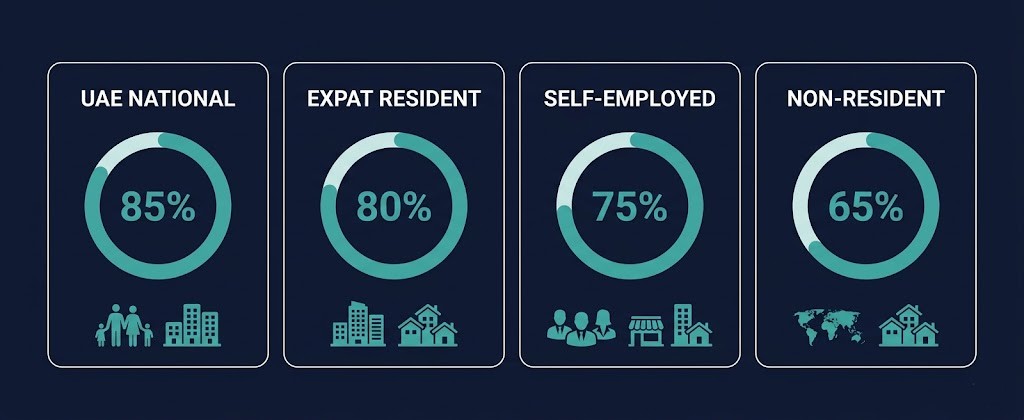
Loan-to-Value (LTV) Ratios: The CBUAE caps how much a bank can lend relative to the property value:
| Buyer Type | Property Value | Max LTV | Min Deposit |
|---|---|---|---|
| UAE Nationals | Up to AED 5M | 85% | 15% |
| UAE Nationals | Above AED 5M | 75% | 25% |
| Expat Residents (first purchase) | Up to AED 5M | 80% | 20% |
| Expat Residents (second property) | Any | 65% | 25% |
| Self-Employed Residents | Any | 75% | 25% |
| Non-Residents | Any | 60–65% | 35–40% |
| Off-Plan (all buyers) | Any | 60% | 40% |
AECB Credit Check: Every UAE bank pulls your Al Etihad Credit Bureau (AECB) score before approving any mortgage. A score above 580 is generally considered acceptable. A broker can advise you on this before any formal application is submitted, which protects your credit record from unnecessary hard inquiries.
Stress Testing: Banks also stress test your affordability at a rate above your quoted rate to ensure you can still service the loan if EIBOR rises. This is standard under CBUAE underwriting rules.
Understanding these limits before you approach any lender means you walk in knowing exactly where you stand — and a good broker will run this assessment with you in your first consultation.
Which Mortgage Broker in Dubai Is Best for Your Specific Buyer Profile?

The best mortgage broker in Dubai for you depends entirely on your residency status, income type, and property goal. The broker who works best for a salaried British expat buying in Business Bay is not necessarily the right fit for a self-employed Pakistani investor buying off-plan in JVC.
Here’s how to match broker criteria to your profile:
Salaried Expat Residents
You’re the most straightforward profile for UAE lenders. The key variables are your monthly salary (minimum AED 10,000 for most banks), your DBR position after existing liabilities, and your employer’s standing. A broker should compare fixed versus variable rate options across at least 10 lenders and show you the total 5-year cost — not just the first year’s rate.
What to ask: Which banks currently have the sharpest 3-year fixed rates for my income level, and what does the variable period look like after the fixed period ends?
Self-Employed Residents
This is where broker expertise matters most. UAE banks vary significantly in how they assess self-employed income. Some require two years of audited accounts. Others accept one year with strong bank statements.
Some banks apply a discount to stated income (often 70–80%) when calculating DBR. Getting the wrong bank for a self-employed profile means delays, additional documentation requests, or outright declines that damage your AECB file.
CityMortgage works with self-employed residents holding UAE trade licences from as little as one year in business. We know which of our 25+ bank partners are currently most receptive to business owner applications and which income documentation they’ll accept — before we submit anything.
What to ask: Which banks currently approve self-employed buyers at my business age and income level, and what documentation do they specifically need?
Non-Resident International Investors
Non-residents can absolutely get a UAE mortgage — this is one of the most persistent myths in the market. LTV is capped at 60–65%, the minimum deposit is typically 35–40%, and the maximum tenor is 25 years. Eligible for both salaried and self-employed international buyers.
The challenge is that the lender’s shortlist for non-residents is shorter. Not all 25+ banks offer non-resident mortgages, and those that do have specific country-of-income requirements. A broker with genuine non-resident experience knows which banks are currently active on this profile — and which ones claim to offer it but routinely decline at underwriting.
Read our full guide to non-resident mortgage options in Dubai, including which lenders currently offer finance to international investors.
What to ask: Which banks are actively approving non-resident mortgages right now for buyers from my country, and what’s the realistic approval timeline?
First-Time Buyers
First-time buyers in Dubai often underestimate the full upfront cost. The mortgage deposit is just one part. Budget planning is where a broker adds immediate value. Beyond the deposit, you’ll pay DLD fees, valuation, bank processing, and potentially agent commission — all before you get the keys.
What to ask: What is my total upfront cash requirement for this property, including all fees — not just the deposit?
📋 Your Mortgage Broker Evaluation Checklist:
- RERA-registered (ask for ORN number)
- Works with 10+ UAE lenders minimum
- Will provide multiple written offers for comparison
- Transparent fee disclosure (broker earns from bank, not from you)
- Has experience with your specific buyer profile
- Runs AECB check before formal bank submission
- Explains total cost, including DLD fees, not just the mortgage rate
- Provides pre-approval within 20 minutes to 24 hours
- Handles full document submission and lender follow-up
- Offers end-to-end service through DLD registration
● Free eligibility check
Which buyer profile are you?
Select your profile to see your LTV limits, minimum deposit, and exactly what you need to get started.
Select your profile
✓ Selected
UAE expat
Salaried resident, any nationality
✓ Selected
Non-resident
International investor, based abroad
✓ Selected
Self-employed
Business owner, trade licence holder
✓ Selected
First-time buyer
Buying property in UAE for the first time
🏢
UAE expat resident
Salaried employee — any nationality — living in the UAE
80%
Max LTV
under AED 5M
under AED 5M
20%
Min deposit
first property
first property
25 yrs
Max loan
tenor
tenor
Documents you will need
Passport, UAE visa and Emirates ID
Salary certificate — max 30 days old
Bank statements — last 6 months
Pay slips if income is variable
Utility bill as proof of address
CityMortgage note: Minimum salary of AED 10,000/month required. We compare 25+ lenders to find the sharpest fixed rate for your income level and DBR position — pre-approval in as little as 20 minutes.
WhatsApp us — free eligibility check
Replies within business hours · No obligation · No upfront fees
🌍
Non-resident international investor
Based outside the UAE — salaried or self-employed
65%
Max LTV
most lenders
most lenders
35%
Min deposit
required
required
25 yrs
Max loan
tenor
tenor
Documents you will need
Passport and national ID
Salary certificate or proof of income
Personal bank statements — last 6 months
Utility bill as proof of overseas address
Company bank statements if self-employed
CityMortgage note: Not all UAE banks offer non-resident mortgages. We know which of our 25+ lender partners are currently active for international investors — and which accept your country of income. Everything handled remotely.
WhatsApp us — non-resident enquiry
We handle everything remotely · No UAE visit required to start
💼
Self-employed resident
Business owner or trade licence holder based in the UAE
75%
Max LTV
ready property
ready property
25%
Min deposit
required
required
1 yr
Min business
operating
operating
Documents you will need
Passport, UAE visa and Emirates ID
Trade licence and memorandum of association
Personal and company bank statements — 6 months
Audited accounts if available
VAT return invoices — UAE residents
CityMortgage note: Banks assess self-employed income differently — some apply a 70–80% discount to stated income when calculating DBR. We know which lenders are most receptive to business owners and what documentation they accept before we submit anything.
WhatsApp us — self-employed enquiry
We match your profile to the most receptive lender first
🏠
First-time buyer in Dubai
Buying property in the UAE for the very first time
80%
Max LTV
under AED 5M
under AED 5M
20%
Min deposit
required
required
4–6 wks
Typical full
timeline
timeline
Total upfront costs to budget for
20% deposit — minimum for expats under AED 5M
4% DLD transfer fee on the property price
0.25% DLD mortgage registration fee on loan value
Approx. 1% bank processing fee on loan value
AED 2,500–3,500 property valuation fee
CityMortgage note: Most first-time buyers only account for the deposit. On an AED 1.5M property, total upfront cash including all fees is closer to AED 400,000+. We walk you through the full picture in your first free consultation — no surprises.
WhatsApp us — first-time buyer guide
Free consultation · We explain every cost before you commit to anything
Powered by citymortgage.ae
What Are the Total Fees Dubai Property Buyers Pay Beyond the Mortgage Rate?
Beyond the mortgage interest rate, Dubai property buyers pay a set of fixed government and lender fees that many first-time buyers underestimate. A good broker should walk you through all of these at your first meeting — not just the headline rate.
Here is the full breakdown:
| Fee | Amount | Who Pays To |
|---|---|---|
| DLD Mortgage Registration | 0.25% of mortgage value + AED 250 title deed | Dubai Land Department |
| DLD Knowledge & Innovation Fee | AED 10 + AED 10 per drawing | Dubai Land Department |
| Service Partner Fee | AED 4,000 + VAT (standard) | DLD trustee office |
| Property Valuation | AED 2,500–3,500 approx. | Bank-appointed valuer |
| Bank Processing Fee | Approximately 1% of the loan value | UAE Bank |
| DLD Property Transfer Fee | 4% of sale price | Dubai Land Department |
| Real Estate Agent Commission | ~2% of property price | Agent |
A practical example: On an AED 1.5M property with a 20% deposit (AED 300,000) and an AED 1.2M mortgage, your upfront cash requirement beyond the deposit is approximately:
- DLD transfer fee: AED 60,000
- Mortgage registration: AED 3,000
- Valuation: AED 3,000
- Bank processing: AED 12,000
- Agent commission: AED 30,000 (if applicable)
- Total additional costs: approximately AED 108,000
That’s on top of your AED 300,000 deposit. Total cash needed at purchase: around AED 408,000.
Most buyers only account for the deposit. A broker who doesn’t walk you through this full picture in the first meeting is not doing their job.
If you’re wondering how quickly you can move from budget clarity to an approved mortgage, the next section covers the full timeline step by step.
How Long Does Mortgage Approval Take in Dubai, and What Documents Do You Need?
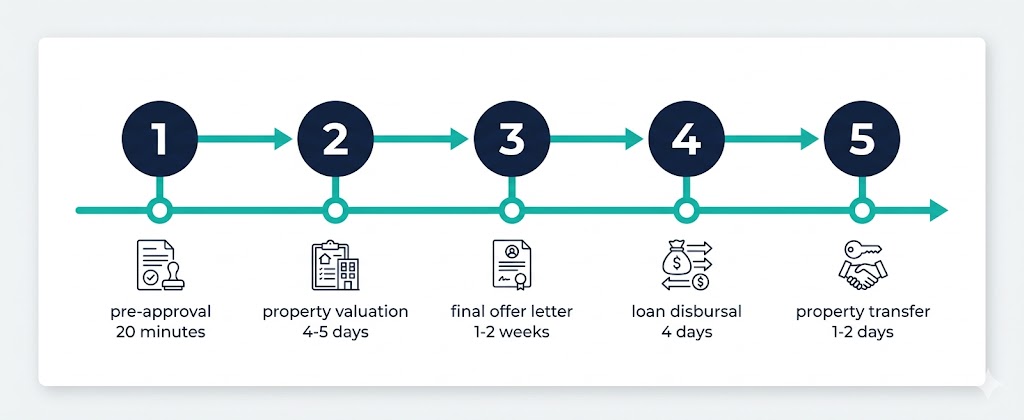
A Dubai mortgage pre-approval typically takes as little as 20 minutes with the right documentation in hand. Full mortgage approval, from pre-approval through to DLD registration, typically runs 4–6 weeks end to end.
Here is the exact timeline:
Step 1 — Pre-Approval: 20 minutes to 24 hours. Submit your documents to your broker. Your broker validates your profile and submits to the relevant bank. Pre-approval letter issued, confirming how much you can borrow. At CityMortgage, pre-approval can be issued in as little as 20 minutes for clients with complete documentation.
Step 2 — Property Valuation: 4–5 working days. Once you have an accepted offer on a property, the bank appoints a registered valuer. The valuation report confirms the bank’s acceptable loan amount for that specific property.
Step 3 — Final Offer Letter: 1–2 weeks. The bank completes underwriting and legal checks, then issues the formal mortgage offer letter. This is the document you sign to proceed.
Step 4 — Loan Disbursal: 4 working days. Funds are transferred to the seller or developer. The mortgage is simultaneously registered with the Dubai Land Department.
Step 5 — Property Transfer: 1–2 days DLD transfer appointment. Manager’s cheque is prepared, title deed transferred to your name, and the property is yours.
Documents required by buyer type:
| Document | Salaried Resident | Self-Employed Resident | Non-Resident |
|---|---|---|---|
| Passport + Visa + Emirates ID | ✓ | ✓ | Passport + National ID |
| Salary certificate (30-day validity) | ✓ | — | ✓ (if salaried) |
| Bank statements (6 months) | ✓ | Personal + Company | ✓ |
| Pay slips (if variable income) | ✓ | — | ✓ |
| Trade licence + MOA | — | ✓ | — |
| Audit report | — | If available | — |
| VAT invoices | — | UAE residents | — |
| Utility bill (address proof) | ✓ | ✓ | ✓ |
The most common reason applications slow down is incomplete documentation at submission. A broker who prepares and reviews your full document pack before approaching any bank saves you 1–2 weeks on average.
Frequently Asked Questions
Can non-residents get a mortgage in Dubai?
Yes. Non-residents — including international investors who do not live in the UAE — can get a Dubai mortgage. The maximum LTV is 60–65%, meaning you’ll need a minimum deposit of 35–40%. The maximum repayment tenor is 25 years, and applications are accepted for both salaried and self-employed non-resident buyers. Not all UAE banks offer non-resident mortgages, so working with a broker who has active relationships with non-resident lenders is important.
What is the minimum down payment for expats buying in Dubai?
Expat residents buying their first property priced under AED 5 million need a minimum deposit of 20% under CBUAE mortgage regulations. For a second property, the minimum rises to 25%. For off-plan properties, the minimum is 40% regardless of buyer type. These are regulatory minimums — some banks may require more depending on their current lending appetite and your profile.
What is EIBOR, and how does it affect my Dubai mortgage rate?
EIBOR (Emirates Interbank Offered Rate) is the benchmark lending rate set daily by UAE banks. Most UAE variable-rate mortgages are priced as EIBOR plus a bank margin (for example, EIBOR + 1.5%). When EIBOR rises, your monthly repayment rises. When it falls, it falls. As of May 2026, the 3-month EIBOR was approximately 3.78%. Fixed-rate mortgage periods (typically 1–5 years) protect you from EIBOR movements during the fixed term.
Is Islamic mortgage finance more expensive than conventional in Dubai?
Not necessarily. Islamic mortgages in Dubai use structures like Murabaha (cost-plus financing) or Ijara (lease-to-own) rather than charging interest. The total cost depends on the specific structure, tenor, and pricing at the time of application — not the label. At current market rates, Islamic and conventional mortgages from lenders like Dubai Islamic Bank, ADIB, and Emirates Islamic sit in overlapping rate ranges with conventional products from Emirates NBD, ADCB, or FAB. A broker who works with both Islamic and conventional lenders can show you a direct comparison for your profile.
What is the difference between a mortgage broker and a mortgage consultant in Dubai?
In practice, the terms are often used interchangeably. A licensed mortgage broker (RERA-registered) is authorised to place mortgage applications across multiple UAE banks on your behalf. A mortgage consultant may refer to an advisor working within a bank or a tied agent who works with a limited panel of lenders. Always check whether the person you’re speaking with is RERA-registered and how many lenders they actively work with — that’s what determines the quality of advice you receive.
Conclusion
The best mortgage broker in Dubai isn’t the one with the most Google ads or the flashiest promise. It’s the one who understands your profile — your residency status, your income type, your deposit position — and matches you to the lender most likely to approve your application at the best available terms.
The checklist is simple: RERA-registered, genuinely independent, access to 25+ lenders, transparent about how they’re paid, and experienced with your buyer profile specifically.
The Dubai property market is moving fast. Over 57,300 residential transactions in just the first four months of 2026 mean competition is real, and timelines matter. Getting your pre-approval sorted before you make an offer isn’t optional — it’s what puts you in the running.
Ready to Get Your Free UAE Mortgage Assessment?
Whether you’re a salaried expat, a self-employed business owner, or an international investor buying remotely, CityMortgage compares 25+ UAE lenders to find the right mortgage for your exact profile — with full transparency and zero obligation.
WhatsApp CityMortgage now at +971 54 206 5454 for a free, same-day eligibility assessment.
